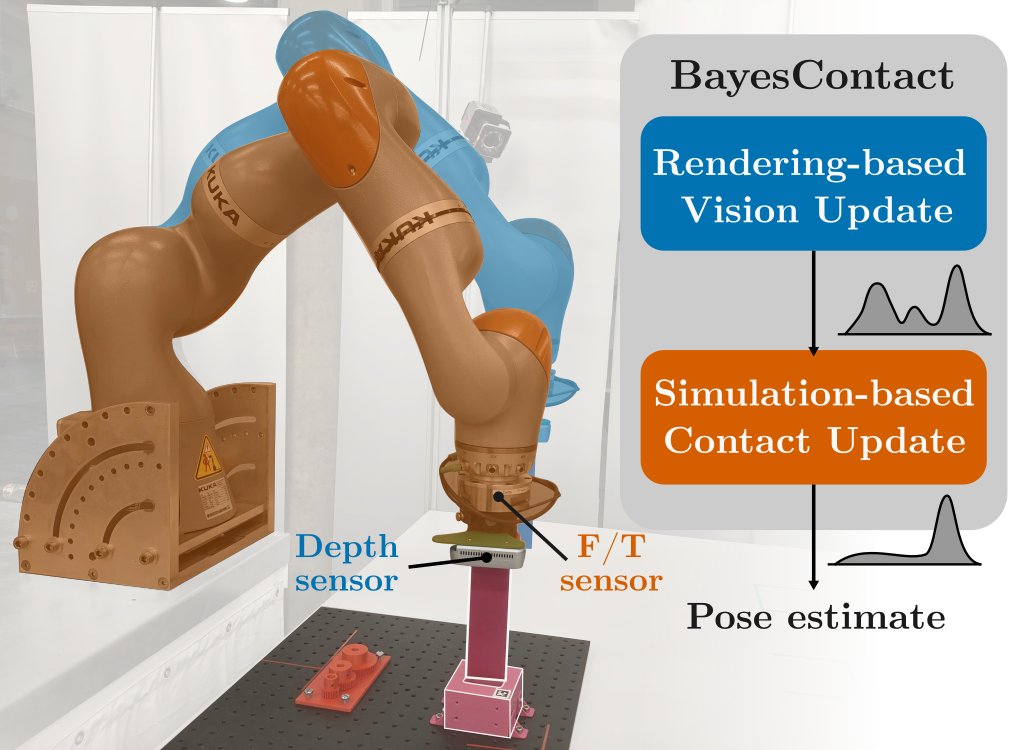
BayesContact: Uncertain Pose Estimation via Visuo-Tactile Proposals and Simulation-based Inference
Under review
TL;DR: Uses vision and contact with simulation-based Bayesian inference to resolve uncertain object pose for manipulation.
Robot Learning · Contact-Rich Manipulation · Probabilistic Inference
I am a final-year PhD student in Robot Learning at the University of Edinburgh, advised by Subramanian Ramamoorthy and Steve Tonneau. My research focuses on enabling robots to reliably perform contact-rich manipulation tasks under uncertainty.
I am particularly interested in how robots can use physical contact as Bayesian evidence about the world. While vision provides broad information about the environment, contact provides local and precise information about geometry, pose, and the state of an interaction. My research explores how these complementary observations can be combined to update beliefs about the environment and improve both perception and control.
A central part of my work is Bayesian inference for robotics. I use Monte Carlo inference methods, including Markov chain Monte Carlo (MCMC) and Sequential Monte Carlo (SMC), to represent and update beliefs under uncertainty. I am particularly interested in combining probabilistic programming languages with simulation-in-the-loop, allowing physics simulators to serve as generative models for inference from visual and contact observations.
I also study how the resulting posterior beliefs can directly inform robot actions. My work combines probabilistic inference with sampling-based planning and control, using contact information not only to estimate the world but also to adapt how a robot explores and interacts with it.
Overall, my research aims to close the loop between perception and physical interaction, using tools from simulation-based inference and control to make robotic manipulation more robust under uncertainty.
Under review
TL;DR: Uses vision and contact with simulation-based Bayesian inference to resolve uncertain object pose for manipulation.
Under review
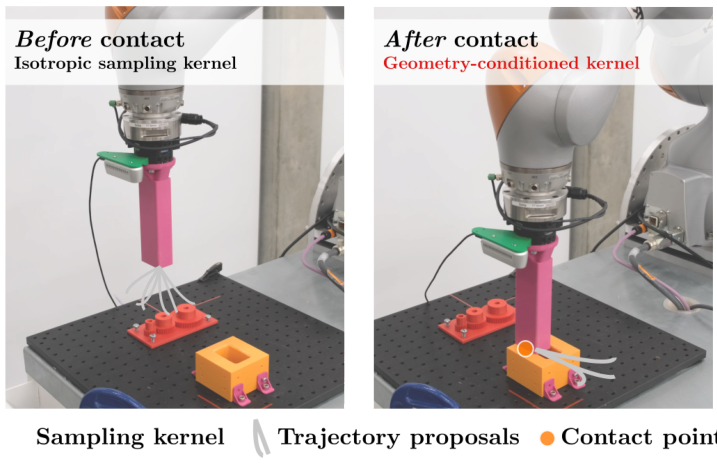
TL;DR: Uses sensed contact to adapt sampling-based MPC proposals, improving contact-rich insertion under uncertainty.
Under review
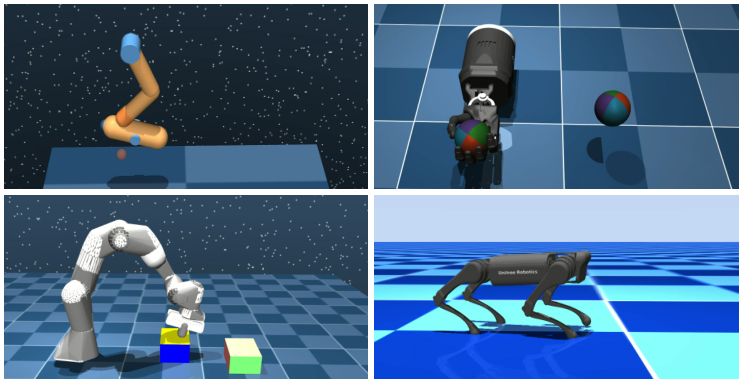
TL;DR: Amortises contact-rich trajectory optimisation into a residual MPC policy using implicit contact differentiation.
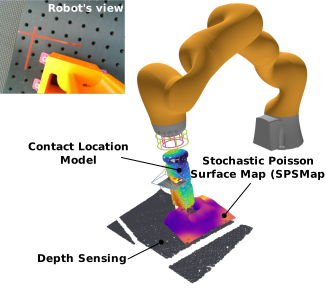
IEEE/RSJ IROS 2026, Pittsburgh, USA
TL;DR: Fuses visual and contact observations in a probabilistic surface map so physical interaction can refine uncertain geometry.
Part of my broader work on contact-rich manipulation is enabling robots to plan and execute motions safely around obstacles. Trajectory optimization and model-predictive control provide powerful tools for reasoning about these motions.
I worked with Sebastian Castro and Sebastian Jahr to integrate Drake's optimization tools into MoveIt as part of Google Summer of Code (GSoC) 2024. We presented the resulting work at ROSCon 2024.